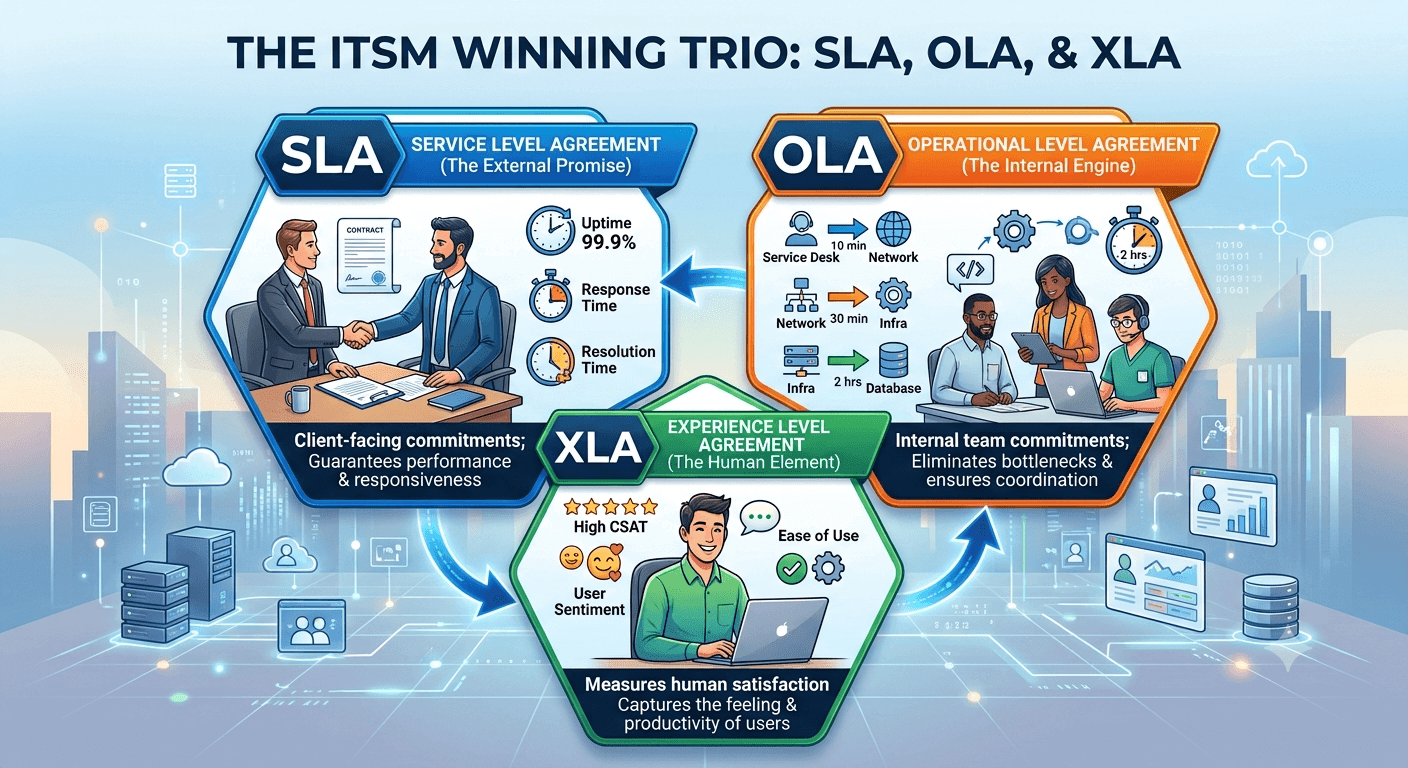

For years, IT Service Management (ITSM) relied on a simple formula: a ticket comes in, IT fixes it, and a timer stops. But in today’s digital-first business environment, speed alone isn’t enough. Delivering exceptional service requires aligning your external promises, your internal team workflows, and the actual human experience.
To achieve this, high-performing IT organizations rely on a powerful framework of three interconnected agreements: SLA (Service Level Agreement), OLA (Operational Level Agreement), and XLA (Experience Level Agreement).
When these three work in harmony, they transform IT from a reactive troubleshooting department into a proactive business partner. Let’s break down each agreement with real-world examples to see how this trio works in practice.
SLA (Service Level Agreement): The External Promise
The SLA is the formal commitment between the IT service provider and the business units or customers it serves. It defines the expected standard of service and sets clear boundaries for response and resolution times.
Real-World Example: Let’s say your company’s Enterprise Resource Planning (ERP) system goes down, halting finance and shipping operations. Your SLA dictates that for a Priority 1 (Critical) Incident, the IT department must respond within 15 minutes and completely resolve or mitigate the issue within 4 hours.
The Metric: 100% of Priority 1 incidents resolved within 4 hours.
The Missing Link: While the SLA tells you what must happen, it doesn’t specify how the internal IT sub-teams need to coordinate to make it happen. That is where the OLA comes in.
OLA (Operational Level Agreement): The Internal Engine
An SLA is impossible to maintain consistently without an OLA. This is an internal agreement between different technical teams within the IT organization. It breaks down the overarching SLA into smaller, team-specific deadlines to prevent bottlenecks and finger-pointing.
Real-World Example (Continuing the ERP Outage): To meet that strict 4-hour SLA to fix the ERP system, the IT department establishes internal OLAs between its specialized units:
Service Desk Team OLA: Identify, log, and route the ERP ticket to the right infrastructure team within 15 minutes.
Network Team OLA: Diagnose potential server connectivity or routing issues within 1 hour.
Database Administration (DBA) Team OLA: If the issue is a corrupted database, isolate and restore the backup within 2 hours.
If the Network team takes 3 hours to do their part, they breach their OLA, which automatically causes a breach of the business-facing SLA. The OLA ensures every internal gear turns at the right speed.
XLA (Experience Level Agreement): The Human Element
raditional ITSM often suffers from the “Watermelon Effect” the dashboard metrics are all bright green (SLAs met, tickets closed on time), but the users are angry and frustrated (red on the inside). The XLA fixes this by measuring the actual sentiment and productivity of the human being using the technology.
XLA focuses on outcomes, feelings, and efficiency rather than just system uptime or stopwatch metrics.
Real-World Example: Imagine a new executive joins the company.
The SLA Approach: IT deploys their new laptop within the standard 3-day SLA window. The ticket is marked “Closed.”
The XLA Reality: The laptop arrived on time, but the executive spent their first 4 hours frustrated because their profile wouldn’t sync, the local printer wasn’t mapped, and nobody explained how to access the secure Wi-Fi. The SLA was a success, but the experience was a failure.
An XLA framework tracks metrics like “Employee Onboarding Sentiment” or “Time-to-Productivity.” It ensures IT checks in to ask: “Did you have everything you needed to start working smoothly on day one?”
The Trio in Action: A Unified Workflow
- [The Goal: XLA] ────────> Minimizing employee frustration during hardware failure.
- [The Promise: SLA] ─────> IT commits to delivering a working laptop within 24 hours.
- [The Engine: OLA] ──────> Helpdesk has 2 hours to triage.
Asset Management has 4 hours to provision the machine. Logistics has 8 hours to deliver it to the user’s desk.
If the internal teams hit their OLA targets, the business gets its SLA fulfilled. Because the process was smooth and integrated, the employee gives a 5-star satisfaction rating, fulfilling the XLA.
Orchestrating the Trio with SimplyDesk
Manually tracking the clock for SLAs, monitoring internal handoffs for OLAs, and gathering sentiment data for XLAs can quickly become overwhelming.
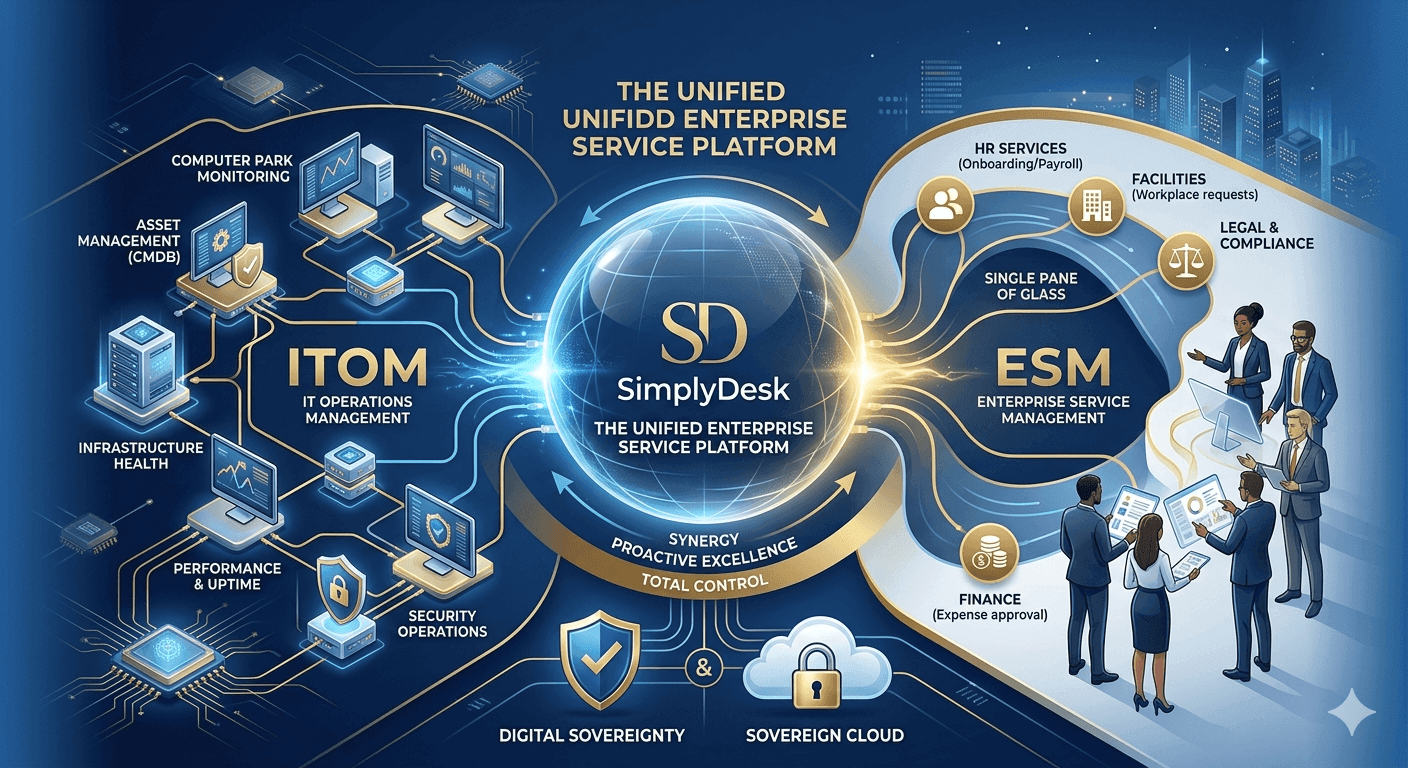
SimplyDesk streamlines this ecosystem by bringing all three layers into a single pane of glass:
Automated SLA & OLA Chains: Set up automated escalation paths. If an internal team is close to breaching an OLA deadline, SimplyDesk can automatically alert managers before it impacts the customer-facing SLA.
Integrated Asset Management (ITAM): Accelerate your OLA execution. When hardware issues arise, technicians can instantly view asset histories, warranty details, and inventory levels inside SimplyDesk’s CMDB, eliminating time-wasting manual lookups.
Continuous Experience Tracking: Capture user sentiment immediately upon ticket closure or through a dedicated user portal, giving you the real-time insights required to measure and continuously improve your XLAs.
By combining the structural discipline of SLAs and OLAs with the empathy and human focus of XLAs, your IT service management becomes truly world-class.
Ready to elevate your IT operations from a helpdesk to an experience-driven value center? Discover how SimplyDesk can transform your workflow today.