
In the era of hybrid work, decentralized operations, and highly mobile workspaces, the boundaries of the traditional IT service desk have permanently expanded. Historically, IT Service Management (ITSM) and IT Asset Management (ITAM) operated in silos. Fixed infrastructure like desktop PCs, server racks, and office routers stayed put, making them easy to log, track, and service.
Today, the workplace relies heavily on movable assets. Laptops travel between homes and offices; tablets move across factory floors; and specialized medical equipment shifts between hospital wings.
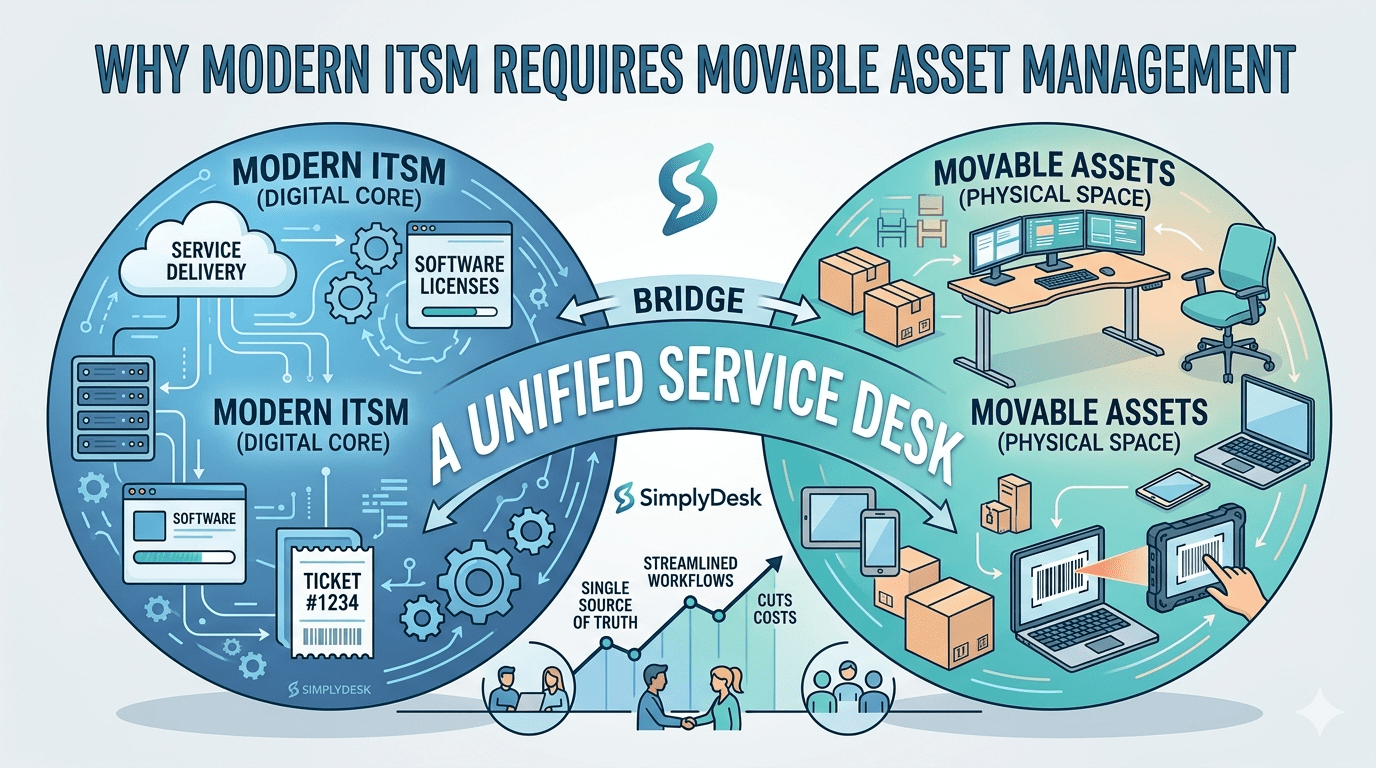
When your service desk cannot seamlessly connect an incoming ticket to a moving piece of hardware, operational efficiency plummets. To eliminate these blind spots, modern organizations are turning to unified platforms like SimplyDesk to bridge the gap between ITSM movable asset management.
1. The Core Problem: The "Movable Asset" Blindspot
When ITSM and asset tracking systems don’t talk to each other, data siloes open up. IT support agents are left blind regarding the physical location, historical context, and ownership of the hardware triggering a support request.
This disconnect creates three distinct organizational pain points:
The Rise of “Ghost Assets”: Organizations routinely pay software licensing fees, insurance, and maintenance costs for mobile devices that were lost or retired months ago.
Costly Ticket Delays: When a remote or mobile employee submits a ticket saying “My device won’t boot,” service agents waste valuable time playing detective manually asking for serial numbers, exact models, or warranty statuses.
Offboarding Security Risks: When an employee leaves a company, an untracked movable asset frequently slips through the cracks. Without a direct link between the HR offboarding ticket and the asset registry, expensive hardware simply walks out the door.
2. The Solution: A Unified Lifecycle Approach
The solution is a single source of truth where service management and movable asset registries live under one roof. When a user files a ticket, the asset’s entire lifecycle data should instantly attach to that ticket.
[Movable Asset Tracked] ➔ [Automatic Context in Ticket] ➔ [Rapid Resolution Time]
With a unified platform like SimplyDesk, if a user reports a hardware issue, the technician instantly sees:
The exact specifications and active warranty of the device.
The user’s historical assignment data.
Past maintenance tickets associated with that specific piece of hardware.
3. Traditional Disconnected IT vs. Unified ITSM movable asset management
The table below highlights how unifying these two frameworks transforms daily IT operations:
| Feature / Scenario | Traditional Disconnected ITSM | Unified ITSM + Movable Asset Management (SimplyDesk) |
| Asset Location & Tracking | Stored in static spreadsheets or separate, isolated inventory software. | Updated dynamically in real-time via user assignment and location tagging. |
| Ticket Resolution Workflows | Agents must manually look up device specs, slowing down resolution times. | Device history, specs, and warranty details automatically attach to the ticket. |
| Employee Offboarding | High risk of lost hardware due to manual checklists. | Automated workflows ensure all assigned movable hardware is flagged for recovery. |
| Financial & Audit Clarity | Difficult to calculate the Total Cost of Ownership (TCO) for mobile fleets. | Complete visibility into ongoing maintenance costs vs. initial asset lifespan. |
4. Industry Deep Dive: The Critical Need in Healthcare
While tracking movable assets is vital for standard corporate offices, it is a matter of operational safety in sectors like healthcare.
Hospitals are the ultimate test for movable assets. Devices like Workstations on Wheels (WoWs), patient tablets, infusion pumps, and mobile diagnostic laptops are constantly on the move across floors, wings, and buildings.
The High Stakes of Hospital Logistics
The Hunt for Equipment: Studies show that nurses can spend significant time per shift simply looking for mobile equipment. If an IT ticket is raised for a faulty mobile workstation, but the technician cannot locate it because it was moved to a different wing, patient care stalls.
The Compliance Hurdle: Medical devices are subject to strict regulatory compliance and audit trails. A unified system ensures every repair ticket, software patch, or hardware calibration is permanently attached to that specific asset’s digital history.
Proactive Maintenance Triggers: Certain movable assets require routing sanitization or safety checks. A unified service desk can automatically trigger preventative maintenance tickets based on how long a mobile asset has been deployed in a specific high-risk zone.
5. How to Implement a Movable Asset Strategy
Transitioning to a unified model doesn’t happen overnight. Organizations should follow a structured deployment framework:
Step 1: Define Your “Movable” Parameters: Explicitly categorize what constitutes a movable asset versus fixed infrastructure within your Configuration Management Database (CMDB).
Step 2: Automate Lifecycle Triggers: Configure your system so that when an asset changes custody or departments, its status and ownership update automatically within the service desk view.
Step 3: Empower End-Users via Self-Service: Provide a user portal where employees can log issues directly against the specific mobile hardware assigned to them, eliminating data entry errors.
Conclusion: Stop Letting Your Hardware Walk Away
In a mobile-first world, managing services without managing the moving assets behind them is a recipe for inefficiency, security gaps, and inflated budgets.
By unifying ITSM and movable asset management into a centralized ecosystem, your IT team gains total operational visibility, slashes ticket resolution times, and eliminates ghost assets entirely.
Discover how SimplyDesk can bridge the gap between your service desk and your mobile fleet today. [Get your Free Trial]